Prof. Dorota Gryko
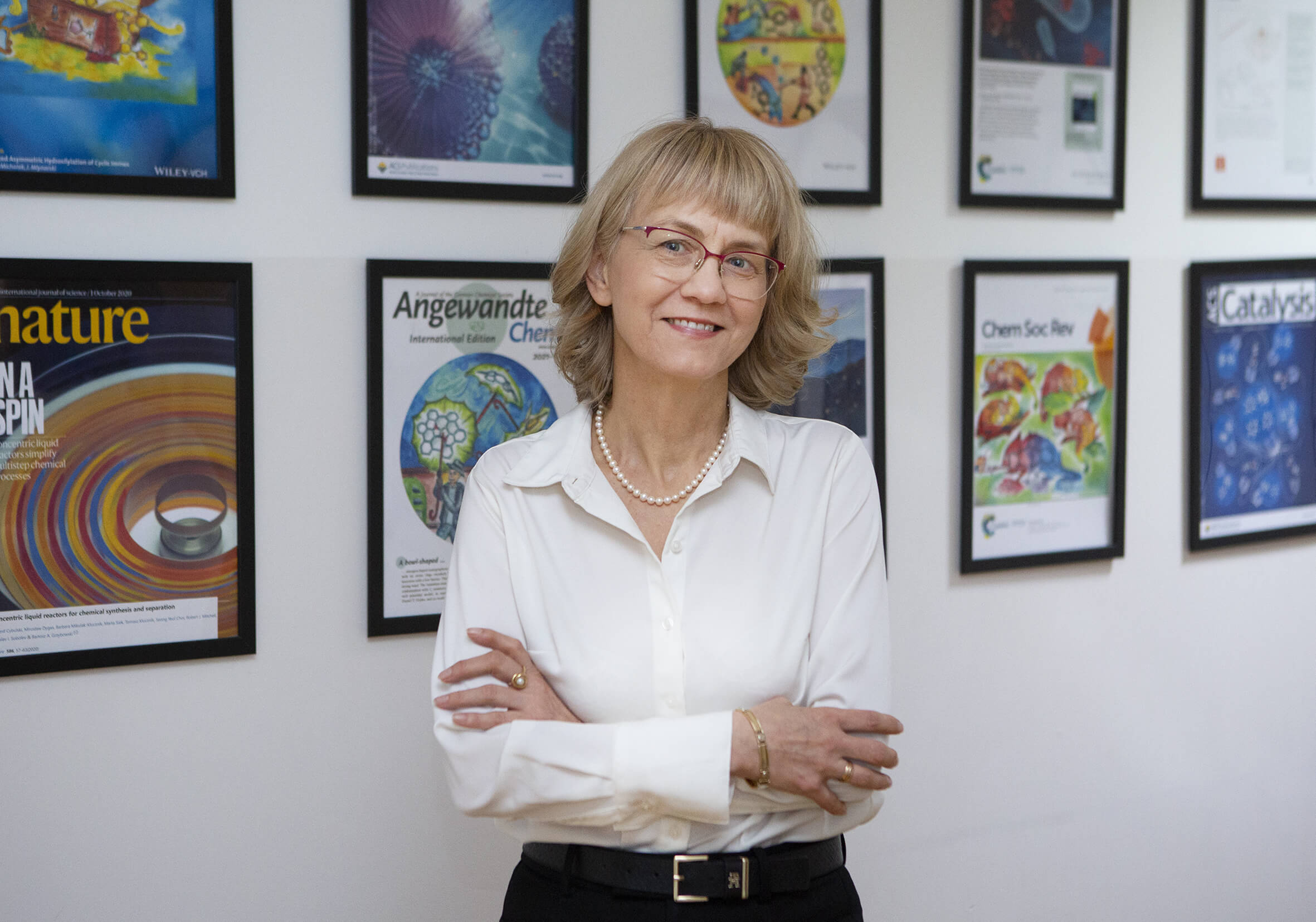
Dorota Gryko graduated with a degree in chemistry from the University of Warsaw in 1994. She continued her academic career at the Institute of Organic Chemistry of the Polish Academy of Sciences in Warsaw, where she earned her doctorate in 1997 and her habilitation in 2008. Between 1998 and 2000, Dorota Gryko completed a postdoctoral fellowship at North Carolina State University (USA). In 2007, she worked as a visiting researcher at the University of Texas at Austin (USA). She secured the title of associate professor of chemistry in 2010 and full professor in 2015.
Professor Gryko specializes in synthetic organic chemistry, particularly photocatalysis (reactions involving light) and nature-inspired vitamin B12-based catalysis, combining classical synthetic approaches with the concept of green chemistry. These strategies are more selective, safer, and environmentally friendly.
Her research has potential applications in more efficient drug synthesis, molecular biology, photopharmacology, and medicine. Prof. Gryko is the author of more than 130 scientific publications, published in prestigious journals such as Angewandte Chemie and Journal of the American Chemical Society. Scholars have cited her research more than 6,000 times. She is also a co-author of four patents and the author of six chapters in scientific books.
Prof. Gryko serves on the scientific councils of the Institute of Organic Chemistry and the Institute of Physical Chemistry of the Polish Academy of Sciences, as well as on the editorial boards of Journal of Porphyrins and Phthalocyanines, Reaction Chemistry & Engineering, Asian Journal of Organic Chemistry, and European Journal of Organic Chemistry. She is a member of the Polish Chemical Society and the Warsaw Scientific Society. In 2023, Prof. Gryko received a nomination for Academia Net, an international platform that showcases profiles of outstanding female researchers.
Prof. Gryko is the recipient of numerous prestigious awards, including the Prime Minister's Award for her doctoral dissertation (1998), the Award of the Minister of Science and Higher Education for outstanding scientific achievements (2019), the Maria Curie Scientific Prize of the Maria Curie-Skłodowska University in Lublin (2019), and the Wojciech Świętosławski Prize of the Polish Chemical Society (2023).
Prof. Gryko is a two-time recipient of a TEAM Programme grant from the Foundation for Polish Science.
One of the most fascinating natural processes is photosynthesis, namely the process by which plants convert light energy into chemical energy. For decades, scientists have sought to replicate similar phenomena in the laboratory to carry out chemical reactions in a more efficient, cleaner, and environmentally friendly manner.
This is precisely the field in which Prof. Gryko operates. Her research team has developed unique photocatalysts based on porphyrinoids – natural compounds found, for example, in hemoglobin and chlorophyll. Photocatalysts are special substances that accelerate chemical reactions when exposed to light.
These substances act as intermediaries: they absorb the energy of light and transfer it to the reacting molecules, making reactions proceed faster, under milder conditions, and without the need for high temperatures or toxic heavy metals such as ruthenium or iridium, which are still used in various industrial chemical processes. In practice, this means that molecules which were previously highly unresponsive can, thanks to photocatalysts, be easily converted into desired organic compounds in processes induced by light alone, namely a free and inexhaustible energy source.
Moreover, some of these reactions can take place in an aqueous environment, making them exceptionally environmentally friendly. Prof. Gryko's research is an excellent example of green chemistry in practice – a field of science that seeks to reduce energy consumption, waste emissions, and toxic substances in the chemical industry.
The photocatalysis developed by Prof. Gryko is not only a fascinating science but also a technology of the future that can find applications in many areas of the economy: in the pharmaceutical industry (for the design and production of new medications and complex pharmaceutical compounds), in materials science (for developing advanced dyes), and in molecular biology (for the safe modification of biomolecules, protein labeling, and the study of processes occurring in living cells).
The research of Prof. Gryko demonstrates that chemistry inspired by nature can be both effective, energy-efficient, and environmentally sustainable. Light, which is the basis of life on Earth, can serve to create new molecules and, in the future, perhaps to develop a more sustainable chemical industry. Owing to Prof. Gryko’s work, Poland is currently a global leader in photochemistry and photocatalysis.
